
Quick answer
The best portable heater for most UK homes is a compact ceramic heater of about 1200W with a thermostat and safety cut-offs. At 0.5 kg, the Ofenwerk K1 is easy to carry from living room to bedroom, warms up in about 2 seconds and costs around 16p an hour in typical use.
Quick checklist
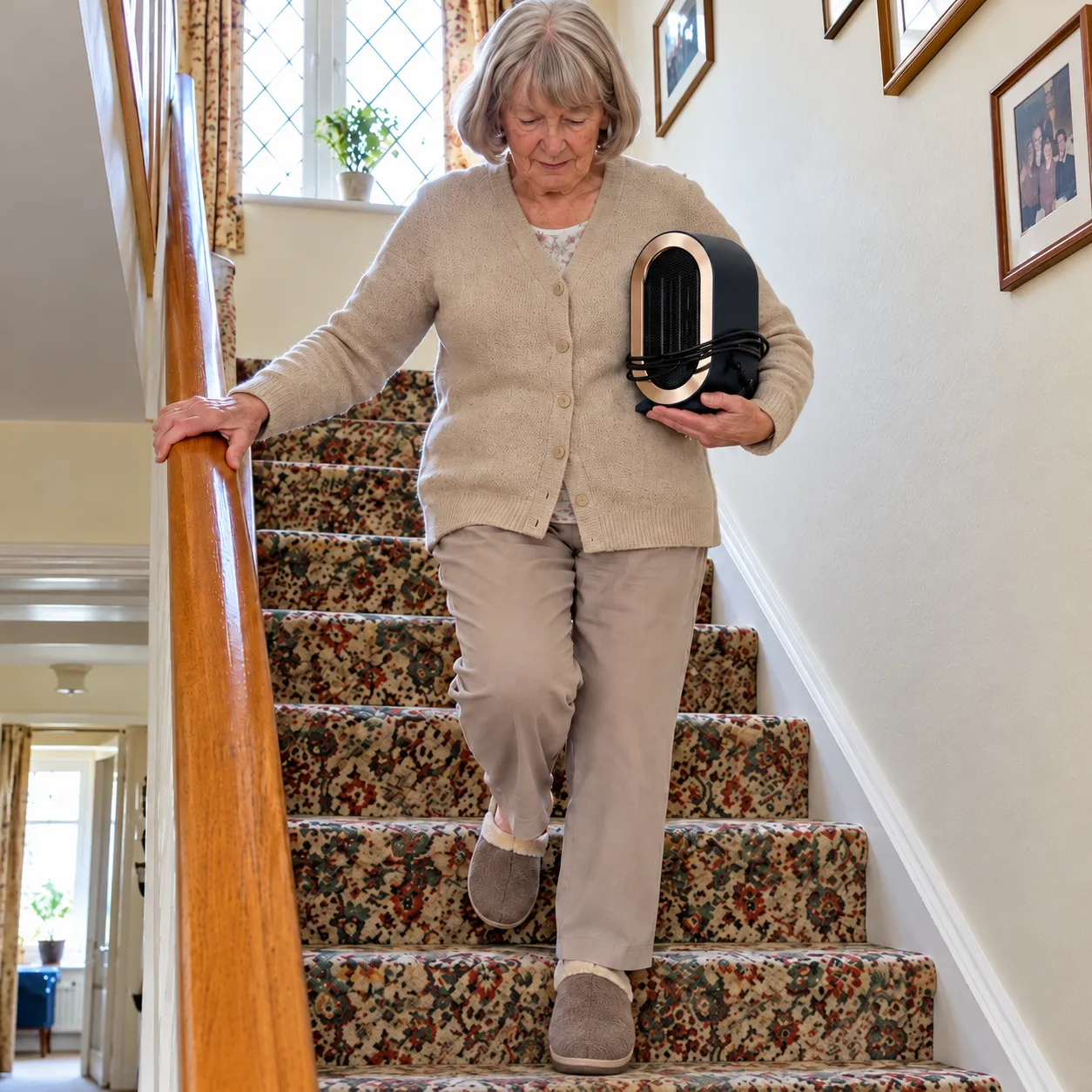
- Light enough to carry with one hand
- Carry handle or compact shape
- Fast warm-up so it's useful the moment you move it
- Tip-over switch, which matters most for a heater that gets moved
- Thermostat so it won't overheat a small room
- Long enough cable to reach the sofa or desk
Why go portable?
Most of us spend the day in one room and the evening in another. One portable heater that moves with you can be cheaper than heating every room.
Portable heater checklist
- Weight under 2 kg, so you'll actually move it
- Fast warm-up: ceramic beats oil-filled for portability
- Thermostat and remote control
- Tip-over, overheat and cool-touch protection
- Quiet enough for a bedroom
Portable heater types
| Type | Typical weight | Warm-up | Portable? |
|---|---|---|---|
| Ceramic (e.g. Ofenwerk K1) | 0.5–2 kg | ~2 seconds | Excellent |
| Coil fan heater | 1–2 kg | Seconds | Good |
| Oil-filled radiator | 8–15 kg | 20–30 min | Poor |
| Convector | 3–6 kg | 10–15 min | Fair |
Cheapest portable heater to run
All electric heaters are about 100% efficient. The cheapest to run is the one that heats only what you need, as fast as possible, then cuts back. That's why a thermostat-controlled ceramic heater usually costs less in practice than a big radiator left on all evening.
What it costs to run (current UK prices)
At the Ofgem price cap of 26.32p per kWh (1 October to 31 December 2026), a 1200W heater like the K1 costs about 32p an hour at full power. Once the room is warm the thermostat switches the heater on and off, so in normal use it averages about 16p an hour.
| How long | Typical cost per day | Over 30 days |
|---|---|---|
| 1 hour | 16p | £4.74 |
| An evening (4 hours) | 63p | £18.95 |
| A working day (8 hours) | £1.26 | £37.90 |
Your own price may be a little higher or lower depending on your region and tariff. See how we calculate running costs or try the running cost calculator with your own unit rate.
Why a portable heater can save money
Most homes only use one or two rooms for most of the day. Moving one small heater with you means you can turn the central heating down a degree or two, or switch off radiators in empty rooms, and still feel warm where you are.
The saving depends on your home and habits, so we don't promise a fixed amount. But heating a 12 m² room with a 1200W heater uses far less energy than heating a whole three-bedroom house.
Portable heaters for older relatives
Portability helps if someone spends the morning in the kitchen, the afternoon in the lounge and the evening in bed. Choose a heater that's light, has simple controls and switches itself off if knocked over.
A remote control helps if bending down is difficult. The K1 has both a remote and buttons on the heater.
Portable vs fixed heaters
Fixed panel heaters and storage heaters are good for rooms used every day for long periods. A portable heater is better for rooms used now and then, such as a spare room, a home office or a conservatory, and for anyone who'd rather not pay for installation.
How the K1 compares with other heaters
| Heater type | Warm in | Running cost | Safety and comfort |
|---|---|---|---|
| Ofenwerk K1 (ceramic) | About 2 seconds | About 16p/hour typical | Tip-over and overheat cut-off, cool-touch case, no glowing coil |
| Coil fan heater (2–3kW) | Seconds | 53–79p/hour at full power | Hot coil, can smell of burnt dust, often noisy |
| Oil-filled radiator (1.5–2.5kW) | 20–30 minutes | 39–66p/hour at full power | Surfaces get hot, heavy to move |
| Convector (2kW) | 10–15 minutes | About 53p/hour at full power | Heat rises to the ceiling first |
| Electric blanket (100W) | 10–20 minutes | About 3p/hour | Warms the bed only, not the room |
Full-power costs worked out at 26.32p per kWh. Thermostats lower all of these in real use.
Using any electric heater safely
These tips follow UK fire-service and Electrical Safety First advice and apply to any portable heater, including ours:
- Plug the heater straight into a wall socket. Don't use an extension lead or adaptor; they can overheat.
- Keep it at least 1 metre from curtains, bedding, clothes and furniture.
- Stand it on a flat, hard, stable surface where it can't be knocked over.
- Never cover it or dry clothes on it.
- Switch it off at the wall when you go out.
- Check the plug and cable now and then. Stop using it if either is damaged or feels hot.
- Make sure you have a working smoke alarm on every floor. Many UK fire services fit them free for older residents.
When the K1 is not the right choice
We'd rather you buy the right heater than return ours. The K1 is probably not for you if:
- You want to heat a large open-plan space over about 20 m² with one heater. Two K1s, or a bigger heater, will do a better job.
- You want a heater fixed to the wall that you never move.
- You need total silence. The K1 has a gentle fan sound, a bit like a quiet laptop.
Our pick: the Ofenwerk K1 Heater
- Warm air in about 2 seconds (PTC ceramic)
- 1200W, heats rooms up to 20 m²
- Tip-over and overheat cut-offs, cool-touch casing
- Thermostat + remote, about 16p an hour typical
- Free UK delivery, 30-day money back, 24-month warranty
Frequently asked questions
How much does a portable heater cost to run?
A 1200W portable heater costs about 32p an hour flat out at 26.32p per kWh, or about 16p an hour with the thermostat cycling.
Are portable heaters safe?
Choose one with tip-over and overheat protection and a cool-touch casing, and keep it clear of fabrics.
Do portable heaters use a lot of electricity?
No more than their wattage. A small 1200W heater uses far less than a 3kW fan heater.
What is the best portable heater for a small room?
A compact ceramic heater of around 1000–1500W with a thermostat and tip-over switch. It warms a small room quickly without overheating it.
Can I take a portable heater on holiday or to a caravan?
Check the caravan or site's electric hook-up limit first. Many hook-ups are 10 or 16 amps, and a 1200W heater uses about 5 amps, which leaves room for other appliances.
Are portable heaters expensive to run?
It depends on wattage and how long you use them. A 1200W heater at today's UK price cap costs about 32p an hour at full power and about 16p an hour in normal thermostat use.
Do portable heaters dry the air?
Ceramic heaters don't burn oxygen or add moisture. Warm air can feel drier because it holds more water before feeling damp. A glass of water nearby or a small humidifier helps if you notice it.
Sources and how we checked this guide
- Electricity price: Ofgem: energy price cap unit rates and standing charges, checked 25 October 2026.
- Heater safety: UK fire and rescue service advice and Electrical Safety First guidance on portable heaters.
- K1 figures (1200W, about 2-second warm-up, room size up to 20 m², safety cut-offs) come from the product specification.
- Costs are worked out with the method on how we calculate running costs.