
Quick answer
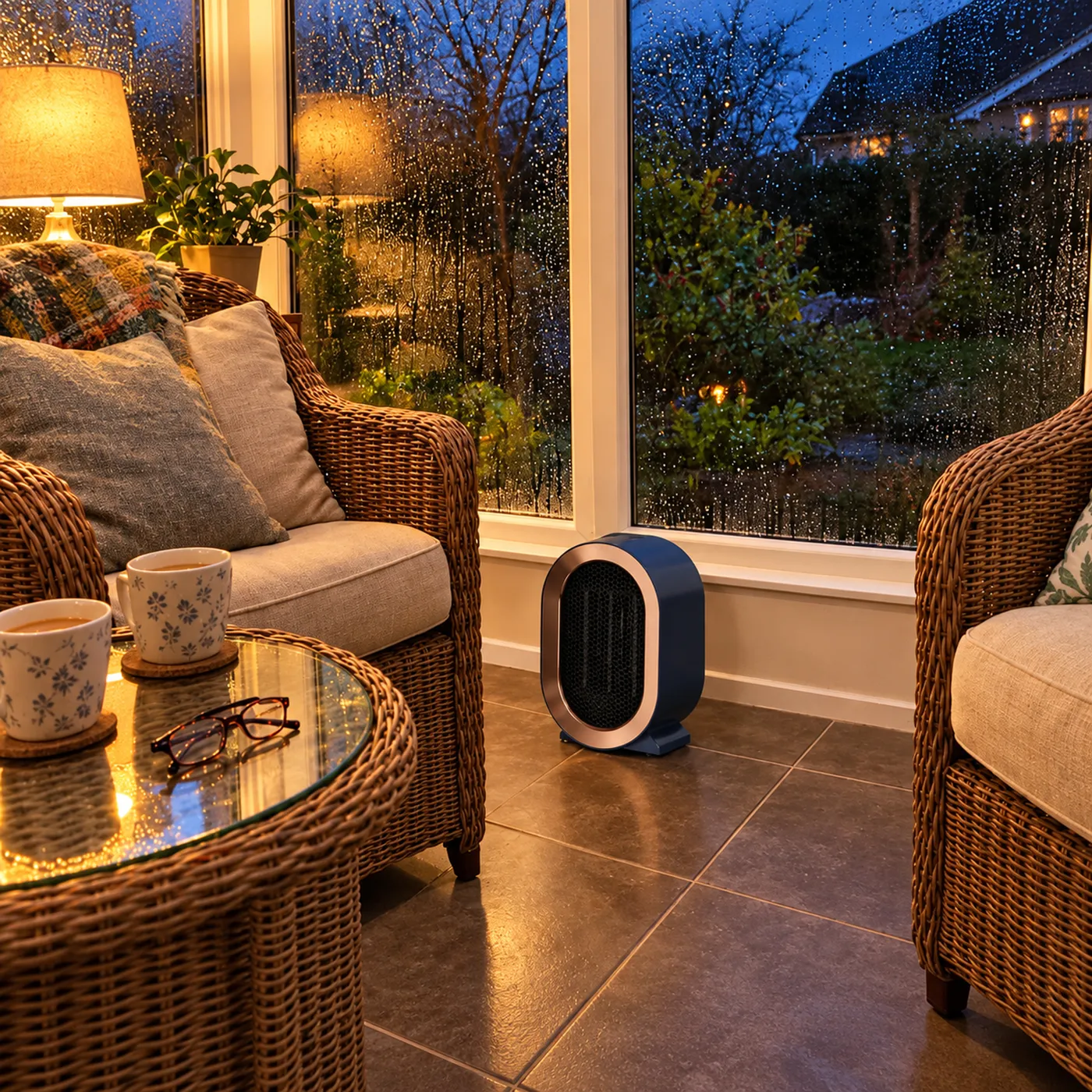
For a UK conservatory, use fast heat only while you're in it, rather than heating it all day. A 1200W ceramic heater suits small conservatories of up to about 15–20 m². Larger or poorly insulated ones may need two heaters. Close the doors to the house and use blinds to hold the heat in.
Quick checklist
- Enough power for glass rooms, which lose heat fast
- Thermostat to stop it running flat out
- Tip-over switch, as conservatory floors are often tiled
- Portable so it can come back indoors
- Fast warm-up for short visits
Why conservatories are hard to heat
Glass loses heat many times faster than an insulated wall. A slow radiator spends most of its energy replacing lost heat. Fast, targeted heat while you're sitting there is more cost-effective.
Sizing
| Conservatory | Suggested |
|---|---|
| Small (up to 12 m²) | 1 × 1200W heater |
| Medium (12–20 m²) | 1–2 × 1200W |
| Large (20 m²+) | 2+ heaters, or fixed heating |
Tips
- Fit thermal blinds
- Draught-proof doors
- Use a thermostat
- Keep heaters away from blinds and plants
What it costs to run (current UK prices)
At the Ofgem price cap of 26.32p per kWh (1 October to 31 December 2026), a 1200W heater like the K1 costs about 32p an hour at full power. Once the room is warm the thermostat switches the heater on and off, so in normal use it averages about 16p an hour.
| How long | Typical cost per day | Over 30 days |
|---|---|---|
| 1 hour | 16p | £4.74 |
| An evening (4 hours) | 63p | £18.95 |
| A working day (8 hours) | £1.26 | £37.90 |
Your own price may be a little higher or lower depending on your region and tariff. See how we calculate running costs or try the running cost calculator with your own unit rate.
Why conservatories are hard to heat
Glass walls and roofs lose heat many times faster than brick walls. On a cold day a conservatory can be colder than outside by evening once the sun goes down. Any heater will work harder here than in a normal room.
Getting the most from a heater in a conservatory
- Close blinds at dusk to cut heat loss through the glass
- Close the door to the house so warm air stays where you are
- Use a rug on tiled floors
- Sit close to the heater for quick warmth instead of trying to heat the whole space
- Consider two K1s for a larger conservatory
Is it worth heating a conservatory?
For an hour or two in the afternoon, a small heater makes the room usable through autumn and spring. Heating a conservatory all day in deep winter is expensive with any heater. Building regulations also say conservatories should be separated from the house by an external-quality door if they don't have their own heating controls.
How the K1 compares with other heaters
| Heater type | Warm in | Running cost | Safety and comfort |
|---|---|---|---|
| Ofenwerk K1 (ceramic) | About 2 seconds | About 16p/hour typical | Tip-over and overheat cut-off, cool-touch case, no glowing coil |
| Coil fan heater (2–3kW) | Seconds | 53–79p/hour at full power | Hot coil, can smell of burnt dust, often noisy |
| Oil-filled radiator (1.5–2.5kW) | 20–30 minutes | 39–66p/hour at full power | Surfaces get hot, heavy to move |
| Convector (2kW) | 10–15 minutes | About 53p/hour at full power | Heat rises to the ceiling first |
| Electric blanket (100W) | 10–20 minutes | About 3p/hour | Warms the bed only, not the room |
Full-power costs worked out at 26.32p per kWh. Thermostats lower all of these in real use.
Using any electric heater safely
These tips follow UK fire-service and Electrical Safety First advice and apply to any portable heater, including ours:
- Plug the heater straight into a wall socket. Don't use an extension lead or adaptor; they can overheat.
- Keep it at least 1 metre from curtains, bedding, clothes and furniture.
- Stand it on a flat, hard, stable surface where it can't be knocked over.
- Never cover it or dry clothes on it.
- Switch it off at the wall when you go out.
- Check the plug and cable now and then. Stop using it if either is damaged or feels hot.
- Make sure you have a working smoke alarm on every floor. Many UK fire services fit them free for older residents.
When the K1 is not the right choice
We'd rather you buy the right heater than return ours. The K1 is probably not for you if:
- Your conservatory is over about 20 m² with a glass roof and you want it warm all day in winter.
- You want to replace central heating for the whole house. The K1 heats the room you're in, not every room at once.
- You need total silence. The K1 has a gentle fan sound, a bit like a quiet laptop.
Our pick: the Ofenwerk K1 Heater
- Warm air in about 2 seconds (PTC ceramic)
- 1200W, heats rooms up to 20 m²
- Tip-over and overheat cut-offs, cool-touch casing
- Thermostat + remote, about 16p an hour typical
- Free UK delivery, 30-day money back, 24-month warranty
Frequently asked questions
What is the cheapest way to heat a conservatory?
Heat it only while you're using it, with a fast thermostat-controlled heater, and keep the doors closed.
What size heater for a conservatory?
Glass rooms need more than the usual 100W per m². For a 10–15 m² conservatory, a 1200W heater works for short sessions; for larger spaces use two heaters.
Is an oil-filled radiator better for a conservatory?
Oil radiators are slow to warm a cold glass room. A ceramic heater gives warmth in seconds, which suits short visits.
Can I leave a heater in the conservatory to stop frost?
A heater designed for frost protection with a low thermostat setting is better for that. Don't leave any heater running unattended for long periods.
How much does it cost to heat a conservatory?
With a 1200W heater, about 32p an hour at full power at today's price cap. In a glass room it will run at full power more often.
Sources and how we checked this guide
- Electricity price: Ofgem: energy price cap unit rates and standing charges, checked 25 October 2026.
- Heater safety: UK fire and rescue service advice and Electrical Safety First guidance on portable heaters.
- K1 figures (1200W, about 2-second warm-up, room size up to 20 m², safety cut-offs) come from the product specification.
- Costs are worked out with the method on how we calculate running costs.